
Can IQ Change Over Time
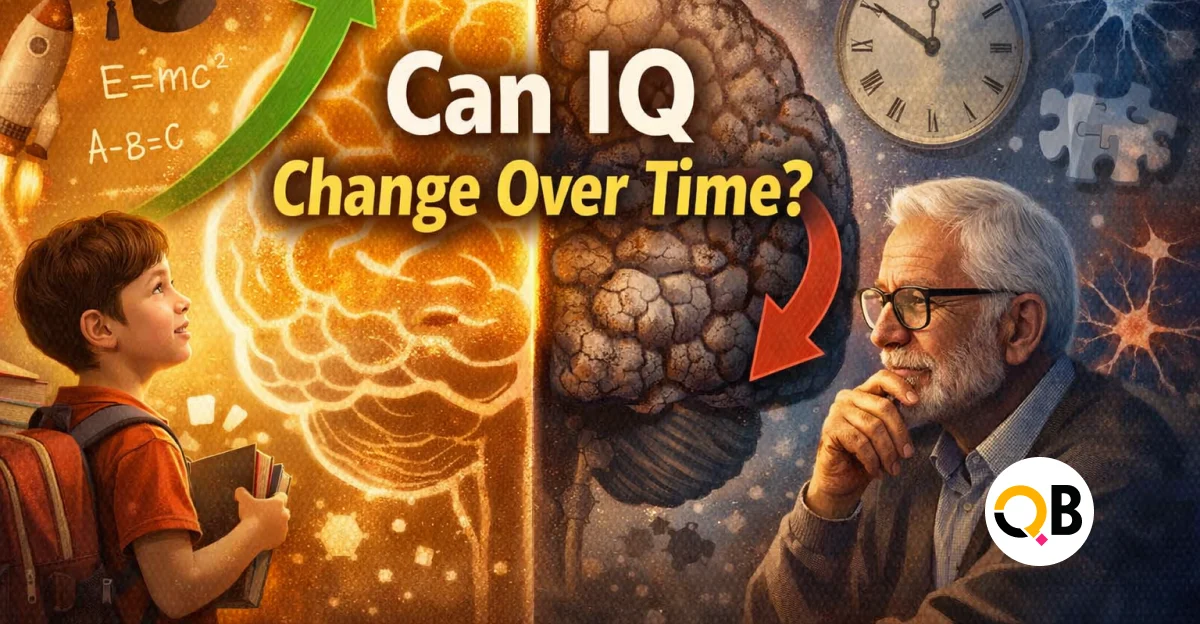
Can IQ change over time, or is it fixed for life?
This question has sparked debate for decades. Many people assume intelligence is something you are born with and that it stays exactly the same forever. Others believe IQ can increase with effort, education, or brain training.
The truth is more nuanced. IQ is relatively stable, but it is not completely fixed. Your environment, age, health, and experiences all play a role in how your cognitive abilities develop and shift over time.
Understanding how IQ works helps separate myth from fact. It also gives you a clearer picture of what intelligence really measures and what it does not.
What IQ Actually Measures
IQ stands for Intelligence Quotient. It is a standardized score designed to measure certain cognitive abilities relative to others in your age group.
Most modern IQ tests assess:
• Logical reasoning
• Pattern recognition
• Verbal comprehension
• Working memory
• Processing speed
• Spatial reasoning
They do not measure creativity, emotional intelligence, social awareness, artistic skill, or practical problem solving in real life situations.
That distinction matters. When people ask whether IQ changes, they are really asking whether these measured cognitive abilities change.
If you are curious how your reasoning skills compare, you can explore the classic structure of an intelligence test with this online IQ test.
Is IQ Stable Across Life?
Research shows that IQ scores tend to be moderately stable, especially from late adolescence onward. However, stability does not mean permanence.
Childhood and Early Development
During early childhood, IQ scores can fluctuate significantly. Brain development is rapid. Language exposure, early education, nutrition, and home environment all strongly influence cognitive growth.
A child’s IQ score at age six may not accurately predict their score at age sixteen. Early testing is more variable because the brain is still wiring itself.
Adolescence
By adolescence, IQ becomes more stable. However, studies have shown measurable increases and decreases during teenage years. Brain regions responsible for executive function and abstract reasoning are still developing.
Educational engagement during this stage can meaningfully impact test performance.
Adulthood
From early adulthood through middle age, IQ tends to remain relatively consistent. However, different cognitive abilities peak at different times:
• Processing speed often peaks in the twenties
• Vocabulary and knowledge can grow into middle age
• Reasoning remains stable for many years
Later in life, some cognitive decline may occur, particularly in speed and memory. However, accumulated knowledge often compensates for this.
So IQ does change over time, but usually within a range rather than through dramatic leaps.
The Role of Education and Environment
Education is one of the strongest predictors of IQ performance.
Extended schooling improves:
• Vocabulary
• Problem solving
• Abstract reasoning
• Working memory efficiency
Research consistently shows that each additional year of formal education can produce measurable increases in IQ scores.
This does not mean intelligence magically appears. It means cognitive skills are strengthened through consistent mental stimulation.
Environment also plays a role. Factors that support cognitive development include:
• Safe and stable home environments
• Access to books and learning materials
• Intellectual engagement
• Social interaction
• Good nutrition
On the other hand, chronic stress, malnutrition, or limited stimulation can suppress cognitive performance.
If you enjoy exploring how thinking styles differ, you may also like this logical reasoning quiz that challenges structured thinking patterns.
Can You Increase Your IQ?
This is where the discussion becomes more complex.
Brain Training and IQ Gains
Short term improvements in test performance are possible through practice. If you repeatedly train on pattern recognition tasks, you may perform better on similar tasks later.
However, many brain training programs improve performance on the trained task itself rather than producing broad increases in overall intelligence.
The Flynn Effect
One of the strongest pieces of evidence that IQ can change comes from the Flynn Effect. Over the twentieth century, average IQ scores rose significantly across many countries.
This was not because humans suddenly evolved genetically. It was largely attributed to:
• Improved education
• Better nutrition
• More cognitively demanding environments
• Increased abstract thinking in modern life
This demonstrates that intelligence, as measured by IQ tests, is sensitive to environmental conditions.
Cognitive Reserve
Engaging in intellectually stimulating activities throughout life may build what researchers call cognitive reserve. This can help maintain mental sharpness later in life.
Activities that support this include:
• Reading regularly
• Learning new skills
• Playing strategy games
• Solving puzzles
• Engaging in complex conversations
If you enjoy mental challenges, this general knowledge quiz offers a broad cognitive workout across subjects.
Does Age Lower IQ?
Aging affects different components of intelligence differently.
Fluid intelligence, which involves reasoning and solving new problems, tends to decline gradually after middle age.
Crystallized intelligence, which includes accumulated knowledge and vocabulary, often continues improving well into later adulthood.
That means older adults may perform more slowly on timed tasks but excel in knowledge based reasoning.
This is why raw IQ scores are always age adjusted. You are compared to people in your own age group.
Genetics vs Environment
IQ is influenced by both genetics and environment. Twin and adoption studies show a significant heritable component. However, heritability does not mean fixed.
Genes set a potential range. Environment influences where within that range someone falls.
For example:
• High quality education can help someone reach the upper end of their cognitive potential.
• Chronic stress or neglect may prevent someone from reaching that potential.
The interplay between biology and environment continues across life.
Understanding your cognitive style can also be interesting from a personality perspective. If you are curious how traits interact with thinking patterns, explore this personality type quiz.
Temporary Factors That Affect IQ Scores
IQ can fluctuate due to temporary conditions that do not reflect permanent intelligence changes.
These include:
• Sleep deprivation
• Stress
• Illness
• Anxiety
• Depression
• Medication effects
Someone who takes an IQ test while exhausted may score lower than when well rested.
Similarly, strong test anxiety can impair working memory and reasoning under time pressure.
This is why one test score should never define a person’s intellectual capacity.
Can IQ Decrease?
IQ scores can decline in certain circumstances:
• Neurodegenerative conditions
• Traumatic brain injury
• Severe chronic stress
• Long term substance abuse
However, healthy adults with stable lifestyles usually experience gradual and mild changes rather than dramatic drops.
Maintaining brain health through sleep, exercise, and intellectual engagement is associated with better long term cognitive outcomes.
If you enjoy measuring your reasoning skills for fun and reflection, the interactive challenges at QuizBombs provide a balanced way to explore your thinking strengths.
What IQ Does Not Tell You
It is important to avoid overinterpreting IQ.
IQ does not determine:
• Your creativity
• Your kindness
• Your emotional intelligence
• Your motivation
• Your life success
Many successful individuals do not have exceptionally high IQ scores. Discipline, resilience, curiosity, and social skills often matter just as much.
IQ measures specific cognitive skills under structured conditions. It is a useful tool, but not a complete picture of intelligence.
Why Understanding IQ Change Matters
Believing intelligence is fixed can be limiting. If you assume nothing can improve, you may avoid challenges.
On the other hand, understanding that cognitive abilities can strengthen through learning encourages growth.
Research in cognitive science consistently supports a balanced view:
• Intelligence has stable components.
• Cognitive performance can improve with effort and environment.
• Lifelong learning supports brain health.
This perspective supports personal development without making unrealistic promises.
Frequently Asked Questions
Can IQ increase in adulthood?
Yes, modest increases are possible. Education, intellectual engagement, and practice can improve certain cognitive skills measured by IQ tests, although dramatic changes are uncommon.
At what age does IQ become stable?
IQ becomes more stable during late adolescence. Before that, childhood scores can fluctuate more due to rapid brain development.
Does studying for an IQ test raise your real intelligence?
Practicing similar tasks can improve performance on those tasks, but it does not necessarily increase overall intelligence. It often improves familiarity rather than underlying ability.
Can stress lower your IQ score?
Yes. Temporary stress, anxiety, lack of sleep, or illness can reduce performance on an IQ test without reflecting permanent intelligence changes.
Is IQ mostly genetic?
IQ has a strong genetic component, but environment plays a major role. Education, nutrition, and life experiences significantly influence cognitive development.