
What Is the Average IQ? Country, Age, and Percentiles Explained
If you’ve ever searched for “What is the average IQ?” you’re certainly not alone. It’s one of the most common questions people ask after taking an intelligence test or becoming curious about how IQ scores are measured.
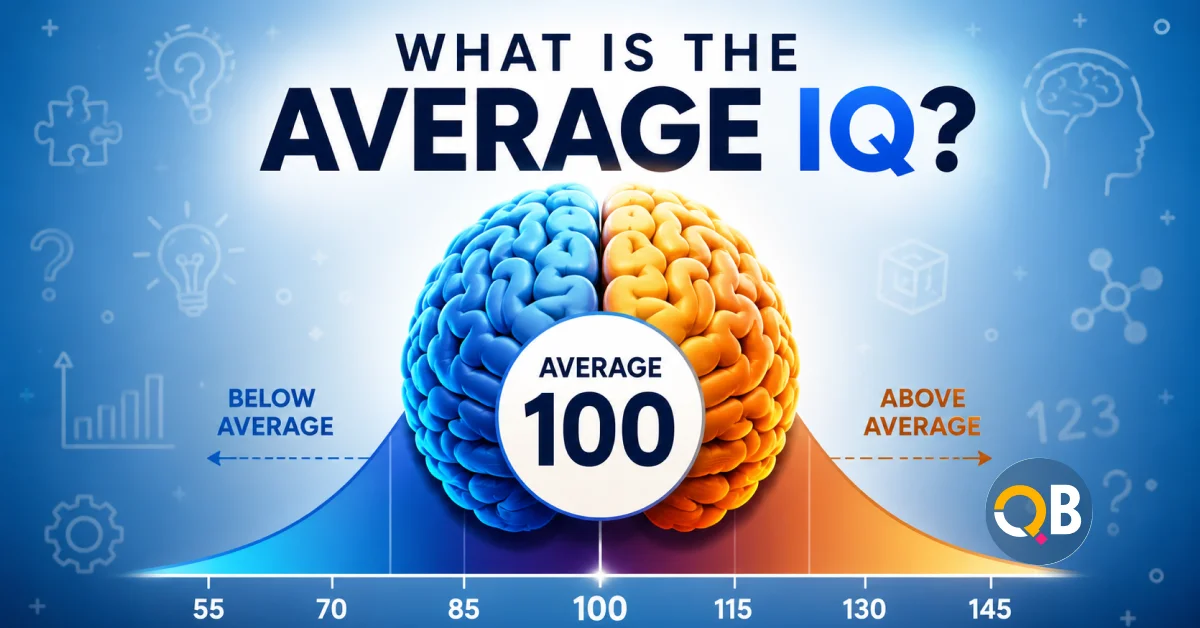
The answer is straightforward at first glance. The average IQ is 100. However, understanding what that number really represents is far more interesting than the number itself.
An IQ score is not simply a measure of how “smart” someone is. Instead, it compares your performance with others in your age group using standardized tests designed to assess reasoning, problem solving, memory, pattern recognition, and other cognitive abilities.
Many people also wonder:
- Is an IQ of 110 considered good?
- Does average IQ change with age?
- Which countries have the highest average IQ?
- What does the 90th percentile actually mean?
- Can IQ improve over time?
This guide answers those questions while separating scientific evidence from common myths. Whether you’re preparing for an IQ assessment or simply curious about how intelligence testing works, you’ll gain a clearer understanding of how IQ scores are calculated and interpreted.
If you’re new to intelligence testing, our guide on What Is an IQ Test? Everything You Need to Know provides a helpful introduction before exploring the numbers in more detail.
Why Is the Average IQ 100?
One of the biggest misconceptions about IQ scores is that they are based on answering a fixed percentage of questions correctly.
In reality, modern IQ tests use a statistical model called standardization.
When psychologists develop an IQ test, they administer it to thousands of people representing different backgrounds and age groups. The results are then adjusted so that:
- The average score is always 100
- Most people fall close to that average
- Higher and lower scores become progressively less common
This approach allows IQ scores to remain meaningful across generations, even as education, technology, and society continue to change.
For example, if overall performance improves over several decades due to better education or healthcare, the scoring system is recalibrated so that the average remains 100 for future test-takers.
This means an IQ score is always relative to the current population, not an absolute measurement of intelligence.
Understanding the IQ Score Range
Although every individual is unique, IQ scores generally follow a bell-shaped distribution.
Here’s how psychologists typically interpret common score ranges:
- Below 70: Significantly below average cognitive performance. Additional professional assessment may be recommended.
- 70 to 84: Below average range.
- 85 to 115: Average range, where the majority of people score.
- 116 to 129: Above average intelligence.
- 130 and above: Often described as gifted or exceptionally high cognitive ability.
It’s important to remember that these ranges describe statistical comparisons rather than personal worth or future success.
A person with an IQ of 95 and another with an IQ of 105 are both considered well within the average range. In everyday life, those differences are often too small to have any meaningful impact.
Likewise, creativity, emotional intelligence, perseverance, communication skills, and practical experience all contribute to success in ways that IQ alone cannot predict.
Readers interested in the strengths and limitations of online assessments may also find Are Online IQ Tests Accurate? useful for understanding how different tests compare.
What Does an IQ Percentile Mean?
One of the easiest ways to understand an IQ score is by looking at its percentile ranking.
A percentile tells you how your score compares with other people in the same age group.
For example:
- An IQ of 100 places you close to the 50th percentile, meaning you scored about the same as the average person.
- An IQ of 115 is roughly the 84th percentile, meaning you performed better than about 84% of people.
- An IQ of 130 falls around the 98th percentile, placing you among the highest-scoring few percent of the population.
Many people find percentiles easier to understand than raw IQ numbers because they clearly show where a score falls within the broader population.
It’s also worth noting that moving from an IQ of 130 to 145 is statistically much more difficult than moving from 90 to 105 because very high scores become increasingly rare.
Understanding percentiles can help put your results into perspective without placing too much emphasis on a single number.
What Types of Skills Do IQ Tests Measure?
Despite the name, IQ tests do not measure every form of intelligence.
Instead, they focus on several core cognitive abilities that researchers have linked to reasoning and problem solving.
Common areas include:
Logical reasoning
Finding patterns, relationships, and solving unfamiliar problems.
Pattern recognition
Identifying visual sequences, shapes, and abstract relationships.
Readers who enjoy this type of challenge can explore the Pattern Recognition Test to practice one of the most common components of modern IQ assessments.
Numerical reasoning
Working with numbers, sequences, and mathematical logic rather than advanced mathematics.
Verbal reasoning
Understanding vocabulary, analogies, and language-based relationships.
Working memory
Temporarily storing and manipulating information while solving problems.
Because different IQ tests place different emphasis on these skills, scores from separate assessments may vary slightly while still reflecting similar cognitive abilities.
Does Average IQ Vary Between Countries?
One of the most searched questions about intelligence is whether average IQ differs from one country to another. The short answer is yes, but interpreting those differences requires care.
Various researchers have published estimates of national average IQ scores using data collected from educational assessments and standardized cognitive tests. These studies often rank countries based on average performance, but they also come with important limitations.
National IQ averages can be influenced by many factors, including:
- Access to quality education
- Nutrition during childhood
- Healthcare and early development
- Economic conditions
- Testing methods
- Sample size and representation
- Cultural and language differences
Because of these variables, scientists generally agree that country averages should not be viewed as fixed measures of a nation’s intelligence. Instead, they are broad statistical estimates that may change as education systems and living conditions improve.
In recent decades, many countries have seen gradual improvements in cognitive test performance, reflecting better access to education and healthier childhood environments.
The most important takeaway is that an individual’s IQ cannot be predicted by their nationality. Personal experiences, learning opportunities, motivation, and environment all play much larger roles in shaping cognitive development than where someone happens to be born.
Does IQ Change With Age?
This is another question that often surprises people.
The answer depends on what we mean by “IQ.”
IQ tests are designed so that the average score remains 100 for every age group. That means a 12-year-old and a 40-year-old can both have an IQ of 100, even though their actual knowledge and life experience are very different.
What changes over time are the underlying cognitive abilities.
Researchers often distinguish between two broad types of intelligence:
Fluid intelligence
Fluid intelligence involves solving new problems, recognizing patterns, and thinking abstractly without relying on previously learned knowledge.
This ability tends to develop through adolescence and early adulthood before gradually declining later in life.
Crystallized intelligence
Crystallized intelligence refers to accumulated knowledge, vocabulary, and skills gained through education and experience.
Unlike fluid intelligence, this often continues improving well into middle adulthood.
Because IQ tests compare you with others in your own age group, these natural changes are already accounted for during scoring.
If you’d like to explore this topic further, our article Can IQ Change Over Time? looks at what research says about learning, brain development, and cognitive growth throughout life.
What Is Considered a Good IQ Score?
Many people ask whether their score is “good enough.”
In reality, there isn’t a single number that determines success or potential.
Here’s a general guide:
- 85 to 115 is considered the average range.
- 100 represents the statistical average.
- 110 to 119 is above average.
- 120 to 129 is often regarded as superior cognitive ability.
- 130 or above is commonly associated with giftedness in many testing systems.
Even so, an IQ score is only one piece of a much larger picture.
A person with an average IQ who is curious, disciplined, emotionally resilient, and motivated may outperform someone with a much higher IQ who lacks those qualities.
Many successful entrepreneurs, artists, athletes, teachers, and leaders demonstrate that persistence, creativity, communication, and emotional intelligence are equally valuable contributors to achievement.
If you’ve recently completed an assessment and want to better understand your results, taking a second well-designed test can provide additional perspective. The Accurate IQ Test offers a more comprehensive challenge than a quick screening while remaining accessible for general users.
Common Myths About IQ
Despite more than a century of research, several myths about IQ continue to circulate online.
Myth 1: IQ Measures Every Kind of Intelligence
IQ tests primarily measure reasoning and problem-solving abilities.
They do not directly assess creativity, emotional awareness, leadership, artistic talent, wisdom, or practical life skills.
For example, someone may excel at solving abstract puzzles while another person shines at building relationships or leading teams. Both forms of ability are valuable.
If you’re interested in understanding another important aspect of human ability, our guide on IQ vs. EQ: What’s the Difference? explains how cognitive intelligence and emotional intelligence complement each other.
Myth 2: Your IQ Never Changes
While genetics influence cognitive ability, environmental factors also matter.
Education, nutrition, sleep, stress management, and lifelong learning can all affect how well someone performs on cognitive tasks.
Although dramatic changes in IQ are uncommon, cognitive abilities are not completely fixed.
Myth 3: A High IQ Guarantees Success
Research consistently shows that intelligence is only one predictor of achievement.
Career success and life satisfaction are also influenced by:
- Motivation
- Conscientiousness
- Emotional intelligence
- Social skills
- Opportunity
- Persistence
- Good decision-making
A high IQ can be an advantage in many situations, but it is far from the only ingredient for success.
Why People Take IQ Tests Today
Modern IQ tests are no longer used only in educational or clinical settings.
Many people choose to take them for entirely personal reasons, such as:
- Challenging themselves with logical puzzles.
- Exploring their strengths in reasoning and pattern recognition.
- Preparing for graduate assessments or aptitude tests.
- Tracking cognitive performance over time.
- Satisfying their curiosity.
Online IQ assessments have also become increasingly popular because they make cognitive challenges more accessible than ever before.
While they should not replace professionally administered psychological evaluations when a formal diagnosis is required, reputable online assessments can provide an engaging way to explore reasoning skills and identify areas for improvement.
If you’re curious about how different types of questions assess logical thinking, numerical reasoning, and abstract problem-solving, the IQ Test is a practical starting point. It combines several common cognitive question styles into a single experience without requiring specialized preparation.
Looking Beyond the Number
It’s natural to compare scores, especially when you see percentile rankings or national averages. However, the most valuable way to think about IQ is as a snapshot of certain cognitive abilities at a particular point in time.
An IQ score can help you understand strengths in reasoning, identify areas to develop, or simply satisfy your curiosity. It should never define your potential, your creativity, or your ability to succeed.
History is filled with people who achieved extraordinary things through perseverance, imagination, emotional intelligence, and continuous learning rather than exceptional test scores alone.
Understanding how IQ works allows you to interpret results with confidence instead of attaching unnecessary meaning to a single number. Whether your score is average, above average, or exceptionally high, it is only one part of what makes you uniquely capable.
Frequently Asked Questions
What is the average IQ?
The average IQ score is 100. Modern IQ tests are standardized so that the average remains 100 for each age group, allowing scores to be compared fairly across the population.
Is an IQ of 120 considered good?
Yes. An IQ of 120 is generally considered above average and places you well above the median. It suggests strong reasoning and problem-solving abilities, although it does not guarantee success in education or career.
What percentile is an IQ of 130?
An IQ of 130 is approximately the 98th percentile, meaning the score is higher than about 98% of people in the same age group.
Can your IQ improve over time?
While IQ is relatively stable, certain cognitive skills can improve through education, practice, healthy lifestyle habits, and continuous learning. Factors such as sleep, nutrition, stress management, and mentally stimulating activities can positively influence cognitive performance. Learn more in Can IQ Change Over Time?.
Are online IQ tests accurate?
Quality varies considerably. Well-designed online IQ tests can provide a useful estimate of reasoning ability and are excellent for practice and self-assessment, but they should not be considered a substitute for professionally administered clinical intelligence tests. Our guide Are Online IQ Tests Accurate? explains the differences in greater detail.
Explore Your Cognitive Skills
Understanding the average IQ provides useful context, but the most meaningful insight comes from exploring your own reasoning abilities rather than comparing yourself with others.
If you’re curious about how you approach logical problems, numerical reasoning, and pattern recognition, you can try the IQ Test. It’s designed as an engaging way to challenge your thinking while helping you better understand the different skills that contribute to intelligence.
Whether your score falls near the average or well above it, remember that intelligence is only one part of what shapes success. Curiosity, persistence, creativity, emotional awareness, and lifelong learning all play equally important roles in reaching your potential.