What Is an IQ Test? Everything You Need to Know
If you’ve ever wondered how IQ tests work or whether they really measure intelligence, you’re not alone. Every year, millions of people search for answers about IQ scores, intelligence testing, and what those numbers actually mean. Some are simply curious, while others are preparing for school assessments, job applications, or personal challenges.
Despite their popularity, IQ tests are often misunderstood. Many people assume an IQ score defines a person’s overall intelligence or predicts future success. In reality, IQ tests are designed to measure specific cognitive abilities rather than creativity, emotional intelligence, wisdom, or life experience.
Understanding what an IQ test can and cannot tell you helps put the results into perspective. Instead of viewing an IQ score as a label, it’s more useful to see it as one piece of information about how your brain approaches certain types of problems.
In this guide, we’ll explore what IQ tests measure, how they work, why they were created, how scores are calculated, and whether online IQ tests are worth taking. Whether you’re considering taking your first test or simply want to understand the science behind intelligence testing, this article covers everything you need to know.
What Is an IQ Test?
IQ stands for Intelligence Quotient, a score designed to estimate a person’s cognitive abilities compared with others of the same age.
Modern IQ tests evaluate how well someone solves problems, recognizes patterns, reasons logically, understands relationships between ideas, and processes information. Rather than measuring knowledge you’ve learned at school, they focus on your ability to think through unfamiliar challenges.
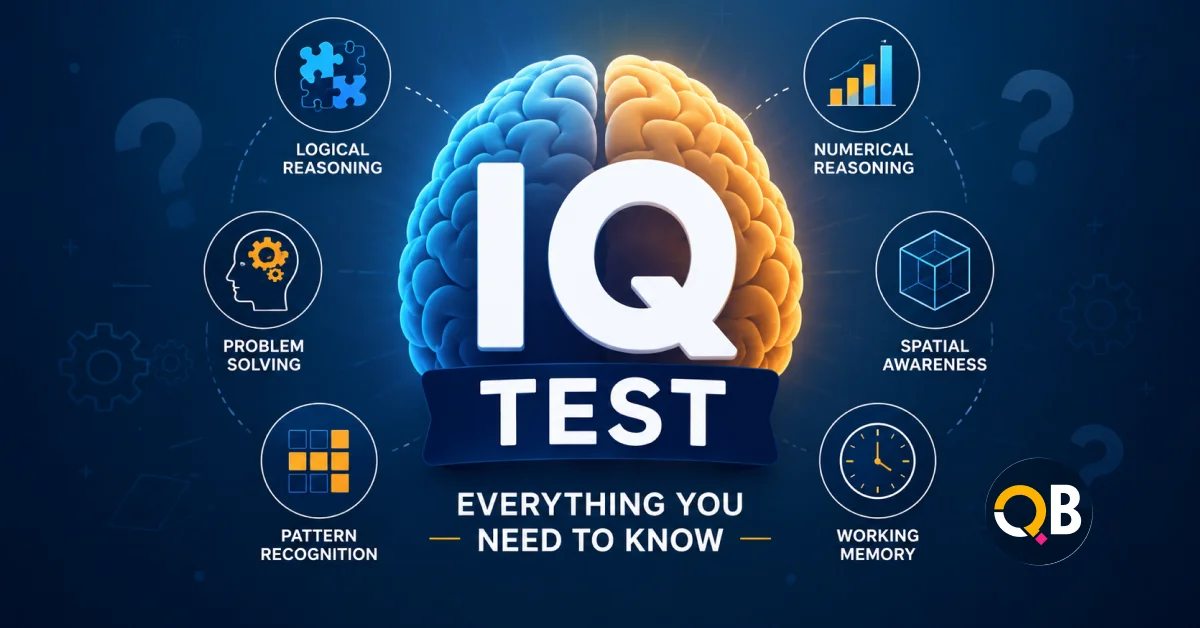
A typical IQ test may assess areas such as:
- Logical reasoning
- Pattern recognition
- Numerical reasoning
- Spatial awareness
- Working memory
- Processing speed
- Verbal reasoning
Each section examines a different aspect of cognitive ability, helping build an overall picture rather than relying on a single skill.
It’s important to remember that intelligence is much broader than what any single test can measure. Creativity, communication skills, empathy, practical problem-solving, and emotional awareness all contribute to how people succeed in everyday life.
Why Were IQ Tests Created?
The history of IQ testing dates back more than a century.
Early psychologists wanted a way to identify children who might need additional educational support. Over time, intelligence testing evolved into a standardized method for measuring certain cognitive abilities across different age groups.
Today, professionally administered IQ tests are used in several settings, including:
- Educational assessments
- Psychological evaluations
- Cognitive research
- Clinical diagnosis
- Some recruitment or aptitude assessments
Modern IQ tests have been refined considerably, using large sample groups and statistical methods to ensure scores are consistent and meaningful.
Rather than ranking people as “smart” or “not smart,” today’s psychologists generally use IQ tests as one tool among many when evaluating cognitive strengths and weaknesses.
What Does an IQ Test Actually Measure?
One of the biggest misconceptions is that IQ tests measure how intelligent someone is in every possible way.
They don’t.
Instead, IQ tests focus on several core cognitive abilities that researchers have found are linked to reasoning and problem solving.
Logical Reasoning
Logical reasoning measures how well you identify relationships, follow rules, and solve unfamiliar problems using structured thinking.
Questions often involve:
- Finding patterns
- Completing sequences
- Identifying missing shapes
- Solving logic puzzles
Pattern Recognition
Pattern recognition is one of the most common components of modern IQ tests.
Instead of relying on memorized knowledge, these questions ask you to recognize visual or numerical relationships and predict what comes next.
This ability reflects fluid reasoning, which involves solving completely new problems.
If you’re curious about these types of challenges, our Pattern Recognition Test offers a practical way to experience this style of reasoning firsthand.
Working Memory
Working memory refers to your ability to temporarily hold and manipulate information.
For example, remembering several numbers while solving a calculation requires strong working memory.
This skill supports learning, concentration, and problem solving across many situations.
Processing Speed
Some IQ tests include timed sections that evaluate how quickly you can process information accurately.
Fast processing speed doesn’t necessarily mean someone is “more intelligent,” but it can influence overall performance on certain assessments.
Verbal Reasoning
Verbal reasoning measures how effectively you understand language, identify relationships between words, and apply verbal concepts.
Not every IQ test emphasizes verbal reasoning equally. Many online IQ tests focus more heavily on visual and logical reasoning because they’re easier to standardize across different languages.
How Are IQ Scores Calculated?
Most modern IQ tests use a statistical model rather than a simple percentage score.
After completing the assessment, your performance is compared with a large group of people in your age range.
The average IQ score is set at 100.
Most people score somewhere between 85 and 115, which represents the middle range of the population.
Generally speaking:
- Below 85 indicates below-average performance on the tested abilities.
- Around 100 represents average cognitive performance.
- Above 115 is considered above average.
- Scores above 130 are relatively uncommon and often described as exceptionally high.
It’s worth remembering that IQ scores are estimates, not exact measurements. Factors such as sleep, stress, health, anxiety, and testing conditions can all influence results.
If you’d like to understand what different score ranges actually mean, our guide on Are Online IQ Tests Accurate? explains why results can vary between assessments and how to interpret them realistically.
Types of IQ Tests
Not all IQ tests look the same.
Different assessments emphasize different cognitive skills depending on their purpose.
Some focus heavily on visual reasoning, while others include verbal knowledge, memory, or mathematical reasoning.
Common types include:
General IQ Tests
These combine multiple cognitive abilities into one overall score and are the most familiar type of intelligence assessment.
Our IQ Test introduces a balanced mix of reasoning challenges designed to help you explore your cognitive strengths in an engaging format.
Logical Reasoning Tests
These assessments focus specifically on deductive reasoning and problem solving.
If you enjoy puzzles and structured thinking, the Logical Reasoning Test provides additional practice with these skills.
Numerical Reasoning Tests
These measure how effectively you recognize mathematical relationships, sequences, and numerical patterns.
Unlike school math exams, they focus more on reasoning than calculation.
Abstract Reasoning Tests
Abstract reasoning removes language almost entirely and focuses on shapes, symbols, and visual relationships.
These tests are commonly used because they minimize the impact of vocabulary and educational background.
Are Online IQ Tests Accurate?
This is one of the most common questions people ask, and the honest answer is: it depends on the quality of the test and your expectations.
A professionally administered IQ assessment conducted by a qualified psychologist follows strict scientific standards. These assessments are carefully standardized, regularly updated, and interpreted alongside other cognitive evaluations.
Online IQ tests, on the other hand, vary widely in quality. Some are thoughtfully designed to measure reasoning skills, while others exist mainly for entertainment and provide little meaningful insight.
A well-designed online IQ test can still be useful because it allows you to:
- Practice different reasoning skills.
- Discover your strengths and weaker areas.
- Become familiar with common IQ-style questions.
- Challenge yourself with new types of problems.
However, it’s important not to treat an online score as an official diagnosis or a definitive measure of your intelligence.
If you’re interested in learning more about the strengths and limitations of digital assessments, read Are Online IQ Tests Accurate?, where we explain what makes some online tests more reliable than others.
Can You Improve Your IQ?
This question has sparked decades of research, and the answer is more nuanced than a simple yes or no.
Your underlying cognitive potential is influenced by both genetics and environment, but many of the skills measured during IQ testing can improve with consistent practice and healthy habits.
For example, you may strengthen:
- Logical reasoning
- Pattern recognition
- Mental flexibility
- Working memory
- Processing efficiency
- Problem-solving strategies
Activities that challenge your brain regularly can help maintain and even improve cognitive performance over time. These include solving puzzles, learning new skills, reading widely, practicing mathematics, playing strategy games, and maintaining an active lifestyle with adequate sleep and nutrition.
Just as athletes improve through training, the brain benefits from regular mental exercise.
If you’d like practical, evidence-based ideas, our guide How to Improve Your IQ explores everyday habits that support cognitive development without making unrealistic promises.
IQ Is Only One Part of Intelligence
One of the most valuable things to remember is that IQ is not the whole story.
A high IQ may indicate strong analytical thinking, but success in life depends on many different abilities working together.
People also rely on:
- Emotional intelligence
- Communication skills
- Creativity
- Adaptability
- Curiosity
- Motivation
- Persistence
- Practical experience
Someone who performs exceptionally well on logical reasoning tasks may struggle with teamwork, while another person with an average IQ may become an outstanding leader because they communicate effectively and understand people.
This is one reason psychologists increasingly look at intelligence from multiple perspectives instead of relying on a single score.
If you’re interested in understanding another important aspect of human ability, our article IQ vs EQ: What’s the Difference? explains how cognitive intelligence and emotional intelligence complement each other in everyday life.
When Should You Take an IQ Test?
There are many reasons someone might decide to take an IQ test.
You may simply be curious about how your reasoning skills compare with typical performance, or you may want to challenge yourself with new types of problems.
An IQ test can also be useful if you:
- Enjoy brain teasers and logic puzzles.
- Want to practice reasoning before an aptitude assessment.
- Are interested in learning more about your cognitive strengths.
- Want to explore different types of intelligence tests.
The key is approaching the experience with the right mindset.
Instead of focusing solely on the final score, pay attention to the kinds of questions you enjoy and the areas where you perform best. These insights are often more valuable than a single number.
If you’re ready to put your reasoning skills to the test, you can try the IQ Test or explore focused challenges like the Accurate IQ Test and Quick IQ Test to experience different styles of assessment.
Frequently Asked Questions
What is an IQ test?
An IQ test is a standardized assessment designed to measure cognitive abilities such as logical reasoning, pattern recognition, problem-solving, working memory, and processing speed. It estimates how your performance compares with people in your age group.
What is considered a good IQ score?
The average IQ score is 100. Most people score between 85 and 115. Scores above 115 are generally considered above average, while scores above 130 are relatively uncommon.
Are online IQ tests accurate?
High-quality online IQ tests can provide a useful estimate of reasoning ability and help you practice common question types, but they should not be viewed as official psychological assessments.
Can your IQ change over time?
Although core cognitive ability tends to remain relatively stable, factors such as education, learning, health, and regular mental exercise can improve many of the skills measured by IQ tests.
Does IQ measure all types of intelligence?
No. IQ tests primarily measure reasoning and cognitive abilities. They do not fully capture creativity, emotional intelligence, practical skills, social awareness, or personal motivation.