What IQ Is Considered Gifted?
If you’ve ever wondered whether an IQ score of 120 is considered gifted, or whether someone needs an IQ of 130 or higher to earn that label, you’re not alone. It’s one of the most searched questions about intelligence testing, and for good reason.
The word gifted is often used in schools, psychology, and everyday conversations, but its meaning can vary depending on the context. Some people associate giftedness with exceptional academic ability, while others think it refers to creativity, problem-solving skills, or simply being “really smart.”
In reality, IQ is only one part of the picture.
A high IQ score can indicate strong reasoning abilities and learning potential, but it doesn’t define a person’s talents, personality, emotional intelligence, or future success. Many gifted individuals excel in certain areas while facing challenges in others, making giftedness a much richer concept than a single number.
If you’re exploring your own cognitive abilities, it can also help to understand how IQ tests work before interpreting any score. Our guide on What Is an IQ Test? Everything You Need to Know explains what IQ tests measure, how scores are calculated, and why different tests may produce slightly different results.
In this guide, you’ll learn:
- What IQ score is generally considered gifted
- Why 130 has become the most widely accepted threshold
- How IQ scores compare across the general population
- Why giftedness involves much more than intelligence alone
- Common myths about gifted IQ scores
- Whether online IQ tests can provide useful insights
Whether you’re simply curious, researching gifted education, or thinking about taking an IQ test yourself, understanding the numbers can help separate facts from common misconceptions.
What IQ Is Generally Considered Gifted?
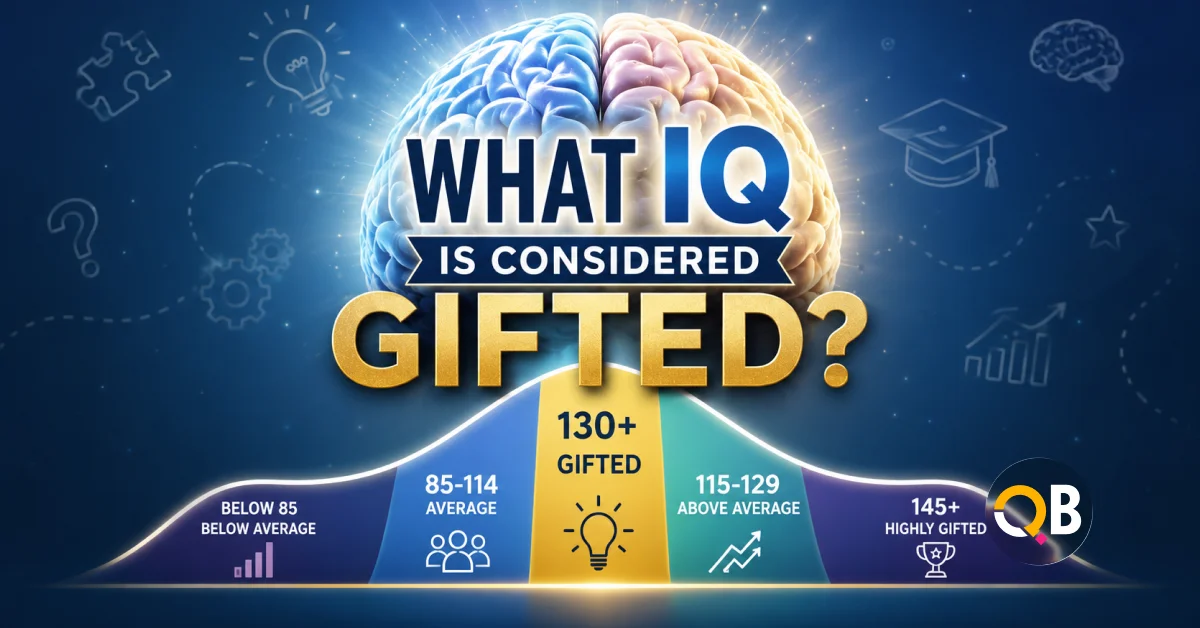
Most psychologists and educational organizations consider an IQ score of 130 or above to fall within the gifted range.
Since IQ tests are designed so that the average score is 100, with most people scoring somewhere between 85 and 115, reaching 130 places someone well above the general population. In statistical terms, only about 2 percent of people score this high on standardized IQ tests.
That is why many gifted education programs use 130 as one of their eligibility benchmarks, although some schools may use slightly different criteria depending on their policies and assessment methods.
Here’s a simplified view of commonly accepted IQ ranges:
- Below 70: Significantly below average
- 70 to 84: Below average
- 85 to 115: Average range
- 116 to 129: Above average
- 130 to 144: Gifted
- 145 and above: Highly gifted or exceptionally gifted, depending on the assessment system
It’s important to remember that these categories are guidelines rather than strict labels. Different IQ tests may use slightly different terminology, and psychologists usually interpret scores alongside many other factors.
Why Is 130 Used as the Gifted Threshold?
The number 130 wasn’t chosen randomly.
Modern IQ tests are built using a statistical model called a normal distribution, often visualized as a bell-shaped curve. Because most people cluster around an average score of 100, scores become increasingly uncommon as they move farther from the center.
An IQ of 130 sits about two standard deviations above the average, making it rare enough to identify individuals whose reasoning abilities are significantly above those of most people.
This threshold has become widely accepted because it provides a consistent way for psychologists and educators to identify students who may benefit from more advanced educational opportunities.
However, it is not a universal rule.
Some gifted programs may identify students with scores beginning around 125, while others require additional testing, classroom performance, creativity assessments, or teacher recommendations before determining whether a child qualifies for gifted education.
Giftedness is rarely determined by a single test score alone.
What Does a Gifted IQ Actually Mean?
A gifted IQ score suggests that someone has unusually strong cognitive abilities compared with people of the same age.
This often includes strengths such as:
- Learning new concepts quickly
- Recognizing complex patterns
- Solving unfamiliar problems efficiently
- Strong logical reasoning
- Excellent memory for certain types of information
- Advanced verbal or mathematical thinking
However, having a gifted IQ does not automatically mean someone will excel in every area of life.
For example, two people with identical IQ scores may have completely different strengths. One may thrive in mathematics, while another excels in language, music, engineering, or creative problem solving.
Likewise, motivation, curiosity, emotional resilience, quality education, and life experiences all influence how someone’s potential develops over time.
This is one reason psychologists avoid treating IQ as a complete measure of intelligence.
As discussed in Can IQ Change Over Time?, cognitive performance can also be influenced by factors such as education, health, sleep, stress, and life experiences. While IQ tends to remain relatively stable throughout adulthood, the abilities that contribute to success continue developing across a lifetime.
Gifted Does Not Mean Genius
One of the biggest misconceptions about IQ is that gifted and genius mean exactly the same thing.
They do not.
The term gifted is commonly used within education and psychology to describe people whose intellectual abilities are significantly above average.
The word genius, on the other hand, is much less precise.
Historically, genius has been used to describe extraordinary achievements rather than simply high IQ scores. Figures such as Albert Einstein, Marie Curie, Leonardo da Vinci, and Isaac Newton are often described as geniuses because of their lasting contributions to science, mathematics, and culture, not simply because of estimated IQ scores.
Someone can have an IQ above 140 without making groundbreaking discoveries, just as someone with a lower IQ may create remarkable works of art, launch innovative businesses, or become an outstanding leader.
Intelligence creates opportunities, but achievement depends on many additional qualities, including persistence, creativity, opportunity, and passion.
Can Online IQ Tests Tell If You’re Gifted?
Many people first become interested in giftedness after taking an online IQ test. While these tests can provide an interesting estimate of your reasoning abilities, it’s important to understand both their strengths and their limitations.
A well-designed online IQ test often measures skills such as:
- Pattern recognition
- Logical reasoning
- Numerical thinking
- Spatial awareness
- Verbal reasoning
These are many of the same cognitive abilities assessed by professionally developed IQ tests. However, a clinical IQ assessment is administered under standardized conditions and interpreted by a qualified professional. Factors such as testing environment, timing, and scoring procedures all help improve accuracy.
That doesn’t mean online IQ tests have no value. In fact, they can be an excellent way to challenge your thinking, identify areas of cognitive strength, and satisfy your curiosity.
If you’re considering trying one yourself, our IQ Test offers a structured set of reasoning questions designed to give you insight into your problem-solving abilities without making unrealistic claims about diagnosing giftedness.
For a deeper look at the strengths and limitations of digital assessments, read Are Online IQ Tests Accurate?.
Signs You May Have Gifted Cognitive Abilities
While only a standardized assessment can estimate an IQ score, many gifted individuals share certain characteristics. These traits are not exclusive to gifted people, nor does having them guarantee a gifted IQ, but they often appear together.
You might recognize some of these tendencies:
- You enjoy solving complex puzzles or logical problems.
- You learn new concepts quickly with minimal repetition.
- You naturally look for patterns and connections.
- You ask thoughtful questions and enjoy exploring ideas in depth.
- You are highly curious across a wide range of subjects.
- You often prefer understanding why something works rather than simply memorizing facts.
Gifted people can also experience challenges that are less commonly discussed. Some become bored in repetitive learning environments, while others may struggle with perfectionism or feel frustrated when their ideas move faster than they can express them.
These experiences remind us that giftedness is about much more than academic performance. Every individual has a unique combination of strengths, interests, and personality traits.
Common Myths About Gifted IQ Scores
There are many misconceptions surrounding giftedness. Let’s look at a few of the most common ones.
Myth 1: A Gifted IQ Guarantees Success
Not necessarily.
Success depends on many factors, including motivation, opportunity, perseverance, emotional intelligence, communication skills, and personal interests. A high IQ may make learning easier in certain situations, but it does not guarantee career achievement or happiness.
Myth 2: Gifted People Excel at Everything
Even highly intelligent people have strengths and weaknesses.
Someone might excel in mathematics while finding writing difficult, or have exceptional verbal reasoning but average spatial skills. Intelligence is complex and rarely balanced across every domain.
Myth 3: IQ Measures Every Kind of Intelligence
IQ tests primarily assess cognitive reasoning abilities.
They do not directly measure creativity, empathy, leadership, artistic talent, practical wisdom, emotional intelligence, or social skills. These qualities can be just as important throughout life.
If you’re interested in how cognitive intelligence differs from emotional intelligence, our guide on IQ vs EQ: What’s the Difference? explores how these two forms of intelligence complement one another.
Myth 4: A Single Test Defines You Forever
One score does not define your potential.
Performance can vary depending on sleep, stress, health, familiarity with testing, and many other factors. Even professionally administered IQ tests are interpreted as estimates rather than perfect measurements.
Your curiosity, willingness to learn, and persistence often have just as much influence on long-term achievement.
Should You Try an IQ Test?
If you’re curious about your reasoning skills, taking an IQ-style assessment can be an enjoyable way to challenge yourself.
Approach the experience with realistic expectations.
Rather than viewing the final score as a label, think of it as one piece of information about how you approach problems. Many people find that the questions themselves are just as interesting as the results.
If you’d like to prepare beforehand, our guide on How to Prepare for an IQ Test offers practical advice on what to expect and how to approach different question types.
Whether your score falls in the average, above-average, or gifted range, it doesn’t determine your value or your ability to learn, grow, and succeed.
Understanding Giftedness Beyond the Number
An IQ of 130 or higher is widely regarded as the benchmark for giftedness because it represents cognitive abilities that are well above the population average. However, giftedness is not simply about achieving a particular score.
Curiosity, creativity, resilience, motivation, and a love of learning all contribute to how people use their abilities throughout life.
Instead of focusing solely on reaching a specific number, it’s often more valuable to understand your own strengths, identify areas where you enjoy learning, and continue developing your skills over time.
An IQ score can open the door to greater self-awareness, but it is only one chapter in the much larger story of human potential.
Frequently Asked Questions
Is an IQ of 120 considered gifted?
Generally, no. An IQ of 120 is considered above average, but most psychologists and educational programs use an IQ of around 130 as the threshold for giftedness.
Is an IQ of 130 rare?
Yes. An IQ of 130 places someone in roughly the top 2 percent of the population, making it significantly less common than average scores.
Can online IQ tests diagnose giftedness?
No. Online IQ tests can provide useful estimates of reasoning ability, but they cannot formally diagnose giftedness. Professional assessments remain the most reliable option for educational or clinical purposes.
Does a gifted IQ guarantee success?
No. Success depends on many factors beyond intelligence, including motivation, education, emotional intelligence, persistence, and opportunity.
Can IQ improve over time?
IQ tends to remain relatively stable throughout adulthood, but cognitive performance can be influenced by learning, health, education, sleep, and life experiences. People can continue developing valuable thinking skills throughout their lives.